

Facing Violence with Courage and Clarity
Practical steps and moral courage for families, faith communities, workplaces, and public spaces.

Disclaimer
This guide is provided for educational and informational purposes only. It draws on options for consideration from the Cybersecurity and Infrastructure Security Agency (CISA), the FBI, and other trusted partners, alongside professional experience. No guide can prevent every incident or replace the role of law enforcement and trained security professionals. Readers are encouraged to adapt these ideas to their own circumstances, seek professional input where appropriate, and always follow the direction of law enforcement and emergency responders in a crisis.
Across the United States, families, faith communities, workplaces, and public spaces are being shaken by violence. Whether it’s a shooting at a church, an armed individual in a public park, or harassment at work, the ripple effects are the same: fear, disruption, and loss of trust in places that should feel safe.
I write this as a certified risk manager who has worked with faith communities across the country. Prior to the regime gutting and changing agencies that were created to keep American citizens safe, I had the privilege of working with CISA agents who were truly dedicated professionals. They developed excellent resources that remain available today — they contain valuable tools for individuals, faith communities, and work places who want to be proactive about safety.
I’ve seen firsthand how vulnerable spaces can feel, but I’ve also seen how resilient people become when they are equipped with simple tools and a clear plan. Safety is not the responsibility of government or law enforcement alone.
It begins with us — with families who talk openly about preparedness, congregations who balance welcome with vigilance, employers who build cultures of prevention, and communities who plan large gatherings wisely.
This guide brings together practical resources from CISA, the FBI, and other trusted partners, alongside real-world stories and lessons learned. It is organized into four sections:
Families & Individuals — everyday habits, situational awareness, and resilience
Faith Communities — balancing open doors with layered safety and hospitality
Workplaces — prevention, reporting, and emergency action planning
Mass Gatherings & Public Spaces — crowd awareness and event planning
The goal is not fear — it is empowerment. By learning simple tools, trusting our instincts, and demanding stronger leadership and accountability, we can keep our communities open, welcoming, and resilient, even in the face of tragedy.
Families & Individuals: Everyday Awareness Without Fear
Violence in public spaces is a heartbreaking reality in America today, and families often feel powerless in the face of it. But there are practical, non-paranoid steps that individuals can take to protect themselves and their loved ones. The goal isn’t to live in fear — it’s to cultivate attentiveness, trust our instincts, and have simple tools to respond if danger arises.
Situational Awareness in Daily Life
Being safe often comes down to noticing what’s around you. That doesn’t mean living on edge — it means building small habits of awareness:
Notice exits when entering public spaces.
Keep phones charged, with location-sharing enabled for a trusted contact.
Avoid distractions like long texting or headphones while walking alone or in public spaces.
Vary travel routes to avoid predictable patterns.
Families can talk about this at the dinner table or while running errands — weaving awareness into everyday life so it becomes second nature.
Building Family Safety Plans
Preparedness brings peace of mind. Families can:
Choose a meeting point if separated.
Practice a quick home evacuation drill.
Teach kids what to do if alarms go off or if others around them start running.
There are free templates and guides to help families create and practice these plans. This is easy enough to teach children as a safety drill — just like “stop, drop, and roll.” These plans don’t need to be complicated — the simpler and more practiced, the more effective.
Trust Your Gut
Research shows many victims later recall having an uneasy feeling before an attack but dismissed it as nothing. That “inner voice” is often the brain detecting subtle danger cues faster than conscious thoughtDe-escalation_Series_1-Recogniz….
When my son was at a park this summer, he found himself within 40 feet of a man angrily waving an AK-47 while kids practiced football on a nearby field. Later, we went back over the situation and realized there had been signs of agitation the man displayed before pulling out the weapon — signs my son had noticed but brushed aside.
The lesson: don’t dismiss your instincts. Safety comes before politeness. If something feels wrong, it probably is. Leave early, even if you can’t explain why.
Run, Hide, Fight (CISA Guidance)
CISA recommends a simple framework for responding to an active shooter situation: Run, Hide, Fight. Because most active shooter situations are over in less than 10 minutes, it’s critical everyone knows how to respond.
Run — If there’s a safe path, evacuate immediately. Leave belongings behind. Help others if you can.
Hide — If running isn’t possible, find a secure hiding place. Lock or barricade doors, silence phones, and stay out of sight.
Fight (last resort) — If your life is in immediate danger and there are no other options, commit to action to disrupt the attacker. Use improvised objects, numbers, or force.
Families can practice this in age-appropriate ways, just as they would a fire drill. The goal isn’t fear — it’s confidence that everyone knows there’s always something they can do.
Suspicious Items: HOT & RAIN
Sometimes the risk isn’t a person but an unattended object. CISA and the DHS Office for Bombing Prevention teach a simple test: is it HOT? Suspicious or Unattended Item.
Hidden — Was it concealed or tucked away strangely?
Obviously suspicious — Wires, electronics, or bomb-like parts visible?
Not typical — Out of place for the environment?
If yes, follow RAIN:
Recognize the indicators.
Avoid the area.
Isolate the item by moving others away.
Notify authorities immediately.
This is easy enough to teach children as a safety drill — just like “stop, drop, and roll.”
Resilience as a Family Culture
Safety is not only about avoiding harm. It’s about resilience — teaching kids and adults alike that when something frightening happens, we stay calm, look out for each other, and keep moving forward. Awareness and preparedness create not only protection, but also hope.
Faith Communities: Safety Without Losing Welcome
Houses of worship are meant to be open and inviting, but today many congregations face difficult questions: How do we protect our community while preserving the spirit of welcome? The balance comes from clear-eyed planning, empowered volunteers, and a culture of paying attention without giving in to fear.
The Power of Hello in Action
A pastor I know once shared a story from their community out west. Their church had been targeted online by members of a local Proud Boys group because the pastor and community were LGBTQ. When one individual showed up, it was the pastor’s elderly father who welcomed the man and invited him to chat.
In his farm overalls and with quiet steadiness, he extended a hand, said hello, and began a conversation. That unexpected welcome disrupted the visitor’s expectations. He left peacefully, even leaving a note saying he would not harm the church.
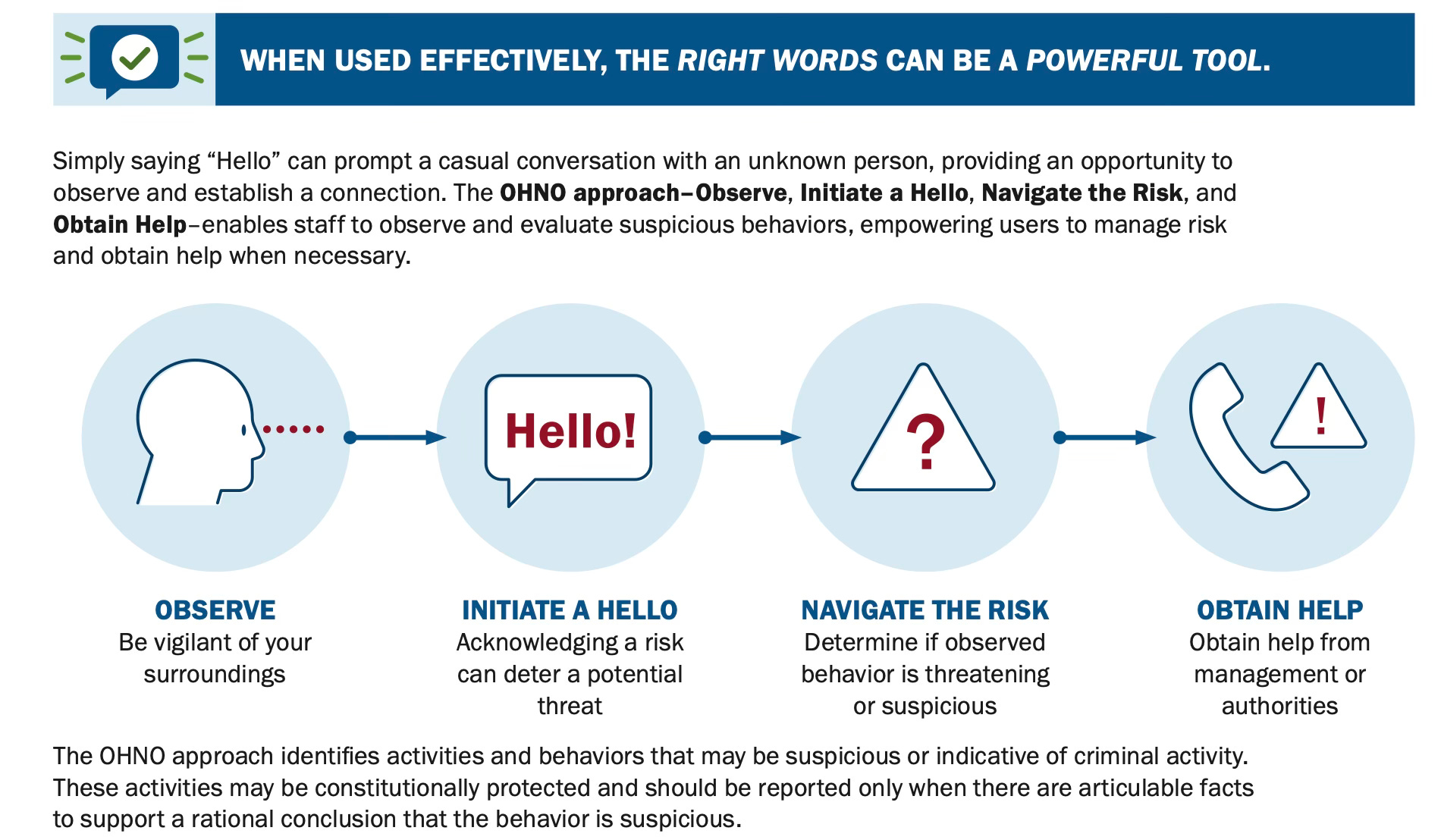
This is exactly what CISA calls the Power of Hello:
Observe what’s happening around you.
Hello — engage with presence and welcome.
Navigate whether behavior is normal or concerning.
Obtain Help from leadership or authorities when needed CISA
A “hello” is not just courtesy. It’s visibility. It tells someone: you are seen, and you matter.
Practical Facility Considerations
Every congregation is different, but some key steps are worth considering. Even small faith communities and houses of worship can implement small changes that can make a huge impact:
Entrances: Once a service begins, limit access to one main entrance. If doors remain open, ensure greeters are stationed there with a specific job — not just to smile, but to pay attention.
Greeters as Safety Eyes: Train greeters to extend a hand, ask a person’s name, and engage briefly. This builds connection and provides a quick assessment of whether someone seems unsettled or out of place.
Communication Signals: Establish a discreet way for greeters or ushers to alert leadership if they spot a concern. This could be a hand signal, a text, or a prearranged phrase. In an immediate emergency, an evacuation cue — such as pulling a fire alarm — could save lives.
Visible Presence as Deterrence
I’ve also heard some law enforcement professionals recommend using visible “Security” vests or jackets for volunteers. Even if greeters are not armed, the visibility alone signals preparedness and can deter someone looking for an easy target. A yellow vest with “SECURITY” on the back is low-cost, non-threatening, and adds credibility to a safety team.
Armed Security: A Serious Decision
If a congregation chooses to allow firearms, best practice is to hire trained professionals. Law enforcement consistently warns that well-meaning but untrained congregants carrying guns can create new dangers, including the risk of injuring fellow worshippers in the chaos of an active threat. Professional security should be licensed, insured, regularly trained, and clearly identified. For many communities, focusing first on greeter training, layered security, and emergency plans may be the safer path.
Building Layered Safety
The Perimeter Security Guide for Houses of Worship emphasizes thinking in three layers:
Outer perimeter (parking lots, lighting, landscaping): Keep spaces visible and deter unauthorized vehicles.
Middle perimeter (entryways, lobbies, windows): Use greeters, radios, and locks. Control access points.
Inner perimeter (sanctuary, classrooms, offices): Designate safe rooms, secure doors, and stock Stop the Bleed and first-aid kits.
Layered safety doesn’t mean creating a fortress — it means making sure each part of the facility contributes to overall resilience.
As difficult as it is to imagine, churches should also prepare for the possibility of vehicle ramming incidents — intentional or accidental. These have become a common tactic worldwide because vehicles are everywhere and can easily be used to harm — just like what happened in Michigan.
CISA recommends separating pedestrian walkways from vehicle lanes, limiting how close cars can get to entrances, and using barriers such as bollards or reinforced planters. For large services or festivals, consider temporary barriers or coordination with police for street closures.
Security Committees & Communication
Every congregation should consider forming a security committee. This group can meet regularly, create a written safety plan, and oversee training. Plans should be shared with staff, greeters, and volunteers — and updated as new risks or lessons arise.
Congregants should also be informed about what to do in emergencies, but leaders should avoid publishing detailed protocols in online bulletins where they could be misused. Instead, communicate safety measures through in-person briefings, member-only emails, or small group sessions. When congregants feel included and prepared, they’re less likely to panic and more likely to respond calmly.
Partnerships with Local Law Enforcement
Congregations should also build relationships with local law enforcement and first responders before a crisis ever occurs. Invite officers to tour the facility, share floor plans, and identify entry points. Establish a designated contact person within the church for safety issues.
It’s important to understand that neither police nor CISA officers will write a safety plan for your church — that responsibility rests with the congregation’s own leadership and security committee. Law enforcement and CISA have full plates and other missions, but they can provide valuable input: reviewing your plan, offering feedback, and suggesting improvements.
This collaboration not only improves emergency response times but also strengthens the credibility of your plan and builds trust between your congregation and local respondersCISA_Protecting_HoW_Perimeter_S….
A Free Self-Assessment Tool
Finally, CISA offers a Houses of Worship Security Self-Assessment Tool — a free online survey that guides leaders through questions about facilities, policies, and practices, then produces a tailored report of vulnerabilities and recommendations. This is an excellent first step for any congregation serious about safety.
Workplace Safety: Building a Culture of Prevention
Violence in the workplace is a serious concern. From healthcare settings to offices, from small businesses to federal facilities, incidents can range from harassment and threats to active shooter events. The key is not only having policies on paper, but creating a culture where prevention, reporting, and preparedness are real and lived out.
Understanding Workplace Violence
The FBI recognizes four types of workplace violence:
Criminal Intent — Violence by outsiders with no relationship to the workplace (e.g., robbery).
Customer/Client — Violence directed at employees by customers, patients, or clients.
Worker-on-Worker — Violence between current or former employees.
Personal Relationships — Violence that enters the workplace from an employee’s personal life (e.g., domestic abuse, stalking).
While media coverage often focuses on extreme incidents, most workplace violence involves threats, harassment, intimidation, or disruptive behavior. These smaller signals, if ignored, can escalate.
Prevention and Awareness
CISA and the Interagency Security Committee emphasize that prevention starts with a multidisciplinary approach:
Clear Policies: Adopt a written workplace violence prevention policy that defines unacceptable behaviors (threats, harassment, intimidation, weapons possession) and outlines reporting channels.
Threat Assessment Teams: Form cross-disciplinary teams (HR, management, security, employee assistance, legal) to review concerning behaviors and develop intervention strategies.
Regular Training: Provide training for all employees on recognizing warning signs, reporting concerns, and knowing what to do in a crisis. Supervisors need additional training in early intervention and documentation.
Risk Assessments: Conduct regular reviews of facilities, work processes, and employee input to identify vulnerabilities and stressors.
Responding to Threats and Incidents
It’s important to learn about de-escalation strategies should an encounter occur. If employees notice warning signs, organizations must respond consistently:
Take threats seriously — explicit or veiled, verbal or written.
Investigate and document every report. Even if a situation seems minor, it should be recorded and addressed.
Engage Employee Assistance Programs (EAPs) to provide support and counseling for employees in distress.
Work with Law Enforcement — build relationships before a crisis, invite police for walk-throughs, and clarify communication channels for emergencies.
Emergency Action Planning
CISA recommends every workplace maintain an Active Assailant Emergency Action Plan.
Evacuation routes and assembly points.
Lockdown and shelter-in-place procedures.
Clear roles and responsibilities (who alerts law enforcement, who secures doors, who communicates with staff).
Recovery plans for supporting employees afterward (counseling, return-to-work policies).
Run, Hide, Fight in the Workplace
As with individuals and families, CISA recommends that workplaces also train employees on Run, Hide, Fight as a response to an active shooter. Practicing these drills helps reduce panic and confusion in the moment, giving employees a framework for survival.
Communication and Culture
The most effective organizations foster a culture where employees feel safe reporting concerns and believe leadership will take them seriously. Anonymous reporting channels, regular safety briefings, and transparent follow-up on incidents build trust. A plan is only as strong as the willingness of people to use it.
Mass Gatherings & Public Spaces: Staying Safe in Crowds
Concerts, festivals, parades, sporting events, and community gatherings bring people together — and with them, unique security challenges. Crowded, open environments can become targets for violence or exploitation. While no plan can eliminate all risks, simple habits and thoughtful preparation can make public events safer for everyone.
The Mass Gathering Security Planning Tool
CISA developed the Mass Gathering Security Planning Tool to help event organizers and community leaders prepare for large gatherings. The tool guides planners through:
Venue characteristics — entrances, exits, parking, and crowd flow.
Security and emergency plans — evacuation, medical support, communications.
Access controls — bag checks, credentialing, ticketing.
Physical security — barriers, lighting, cameras, screening equipment.
Crowd management — trained staff, volunteer coordination, traffic control.
Crowded festivals and parades are particularly vulnerable to vehicle attacks. Organizers can reduce this risk by using temporary barricades, rerouting traffic, or positioning heavy vehicles at road closures. CISA’s Vehicle Ramming Self-Assessment Tool can help event planners identify where crowds are most exposed and what protective measures to put in place.
For individuals and families attending these events, the benefit is knowing that organizers should be considering these factors. Asking questions like “Where are the exits?” or “How would we meet if separated?” puts some of that power back in your hands.
Suspicious Items and Behaviors
Large events often involve bags, equipment, and infrastructure — which makes vigilance important. Remember the HOT test (Hidden, Obviously suspicious, Not typical) and RAIN steps (Recognize, Avoid, Isolate, Notify) for unattended suspicious items.
Also pay attention to behaviors that don’t match the setting: someone lingering without reason, avoiding security, or showing signs of stress or agitation. If your gut says something feels off, report it to event staff or law enforcement right away.
Personal Safety in Crowds:
Families and individuals can take simple steps:
Plan ahead: Identify exits when you arrive. Choose a meeting point in case you get separated.
Stay aware: Keep your phone charged, limit distractions, and watch for crowd surges.
Travel light: Bring only what you need; fewer bags mean faster screening and easier mobility.
Follow instructions quickly if security staff or announcers give directions during an emergency.
Partnerships Make It Stronger
Event organizers should coordinate closely with local law enforcement, emergency medical services, and fire departments. Families and individuals can support this by knowing who to look for — security staff, police officers, medical tents — and being ready to report concerns.
Fusion Centers: Connecting Local Communities with National Security
Fusion Centers are state-owned and operated hubs that bring together federal, state, local, tribal, territorial, and private sector partners to share and analyze threat-related information. They are part of the National Network of Fusion Centers, which provides a unique perspective on local threats while also feeding into the larger Homeland Security picture.
For congregations, workplaces, and event organizers, Fusion Centers can:
Serve as a primary point of contact for sharing suspicious activity or threat concerns.
Provide contextual intelligence — not just what’s happening nationally, but what’s emerging locally.
Strengthen collaboration by connecting frontline personnel with both state leadership and federal resources.
Fusion Centers are not law enforcement replacements — but they are vital resources for integrating information from national and local sources to help prevent and respond to threats. Connect with your local fusion center to get updated notifications.
Safety as a Shared Commitment
Violence is a tragic reality of our time, but it does not have to define us. Families, faith communities, workplaces, and public spaces all have the power to strengthen safety through simple steps: paying attention, trusting instincts, planning ahead, and supporting one another.
Preparedness is not paranoia — it is an act of care. Each greeting at the door, each safety plan reviewed, each family conversation about “what if” is an act of love and care that’s woven into our fabric of resilience. Together, these choices build a culture where communities are not paralyzed by fear, but empowered by hope and awareness.
We cannot control every circumstance. But we can control how we prepare, how we look out for one another, and how we rise after hardship. That is the heart of resilience: seeing clearly, acting wisely, and keeping our communities open and welcoming even in uncertain times.
Safety is strongest when it is shared. By standing vigilant, informed, and connected, we ensure that light and love outshine fear.
A Demand for Action
As a certified risk manager — but more importantly, as a mother — I cannot accept a future where families, faith communities, and schools live in fear.
We demand that leaders from both sides of the aisle come together to deliver a unified message: violence is unacceptable, no matter the source, no matter the party. We demand accountability for groups and individuals who promote violence and division.
We demand meaningful gun reform and stronger protections for our schools, places of worship, workplaces, and public spaces. Communities should not live in fear of weapons designed for war appearing in parks, classrooms, or sanctuaries.
There is evidence of a prior commitment to this responsibility from our government based on all the thorough resources that were previously developed by CISA and shared in this guide.
We must call on our leaders to rise to that responsibility again with courage, clarity, and urgency.
Disclaimer
This guide is provided for educational and informational purposes only. It draws on options for consideration from the Cybersecurity and Infrastructure Security Agency (CISA), the FBI, and other trusted partners, alongside professional experience. No guide can prevent every incident or replace the role of law enforcement and trained security professionals. Readers are encouraged to adapt these ideas to their own circumstances, seek professional input where appropriate, and always follow the direction of law enforcement and emergency responders in a crisis.
This was a thoughtful and brilliant post - thank you so much!
Thank you for this comprehensive post.