

This Is the Line
Seven actions Americans can take right now

I’m not going to sugar-coat this.
We have just endured one of the most brutal weeks since Donald Trump’s presidency, not just in violence, but in speed and scale.
In the days leading up to this weekend, Americans watched reckless threats against other nations and actions that destabilized global markets and alliances in real time.
Then at home this weekend, Alex Pretti was executed in the streets of Minneapolis after trying to defend a woman from being attacked with pepper spray while protesting. People watched it happen. The video exists. Everyone has seen it.
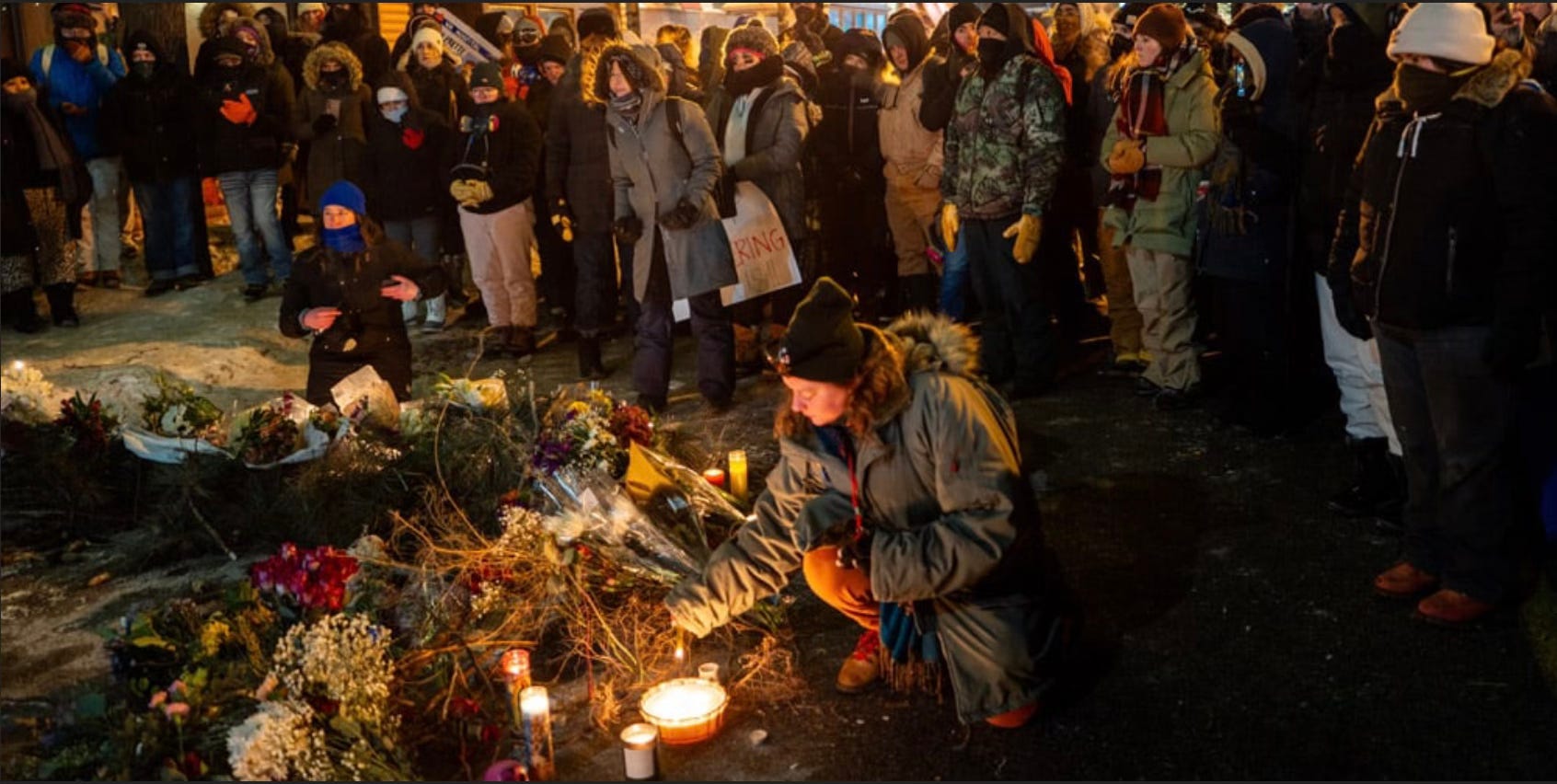
Afterward, instead of accountability, the government smeared his name.
In addition, whistleblower reports have revealed a newly disclosed internal ICE memo that authorizes officers to enter homes without a judge-signed warrant, relying instead on internal “administrative warrants.” This is a shift that legal experts say undermines long-standing Fourth Amendment protections against unreasonable searches and seizures.
Instead of reining these expanded powers in, the House recently passed an appropriations bill that would increase funding for the Department of Homeland Security and ICE by billions of dollars, and that bill is now headed to the Senate this week.
This is not chaos by accident. It is power testing how much it can do, how fast it can do it, and whether anyone will stop it.
This is not normal. It is not abstract. And it is not someone else’s problem.
I am not here to spew toxic positivity. This is a serious and heartbreaking situation. But we are not helpless. People have reached out asking what they can do to push back against ICE. What matters most is that we act — and that we remain peaceful.
What follows is not commentary — it’s action. Clear, concrete steps ordinary people can take right now to demand accountability and refuse consent.
Read it. Share it. Use it.
Honor Alex Pretti and Renee Good
Alex Pretti and Renée Good were assassinated twice — first when they were killed, and again when officials smeared their names to excuse it. We can honor them by sharing who they really were, in the words of the people who loved them most.


These are the people who were taken due to state violence. What follows are peaceful, legal actions Americans citizens can take this week to stop it.
This Friday: Nurses Are Taking Action
This Friday, January 30, nurses and healthcare workers are striking nationwide.

Alex Pretti was an ICU nurse. He spent his life caring for people in crisis. Nurses are now refusing to proceed as business as usual in the face of state violence against one of their own.
If you are a nurse or healthcare worker, support the strike. If you are not, show up in solidarity if you can. If you cannot be there, amplify it.
Collective action is already happening. This is what refusing normalization looks like.
Call Congress — This Week Matters
This week, the Senate will be voting on a government funding package that includes money for the Department of Homeland Security and Immigration and Customs Enforcement (ICE). The House passed this funding bill last week, but opposition to funding ICE is growing in the Senate in response to recent federal killings of U.S. citizens by immigration agents in Minneapolis.
Your call and your email land at the exact moment decisions are being made in Washington. Right now, some Senators are saying they will vote against the bill unless DHS and ICE funding is changed — including conditions tied to accountability, oversight, and limits on enforcement operations.
Even when it feels like no one is listening, calling Congress and sending emails matters. Senators and their staff count call volume and track letters. When votes are imminent like this week, pressure from constituents can influence positions, slow momentum, and change outcomes. Silence gets interpreted as consent. If lawmakers hear from you now, your voice will be counted before the vote.
A practical tool:
Another practical way to make multiple calls quickly is by using the Five Calls app. It provides phone numbers and names for your Senators and Representatives, a variety of issue summaries , and short scripts. It removes friction so more people can apply pressure when votes are imminent.
Below is sample language you can use as a phone script or as text for a written email or letter regarding ICE.
Sample Call / Letter Script
My name is ___, and I am a constituent from ___, ZIP ___.
I am contacting you to state my expectations regarding federal funding for ICE.
I expect you to vote NO on any appropriations bill or continuing resolution that includes funding for ICE. ICE agents killed U.S. citizens Alex Pretti and Renée Good, and I will not support funding an agency that operates without accountability.
Whistleblower reports show DHS authorizing ICE agents to enter homes without a judicial warrant. Congress has an obligation to act when a federal agency claims powers it does not have.
I also expect Congress to order independent investigations into the killings of Alex Pretti and Renée Good, and to file articles of impeachment against Kristi Noem for authorizing and overseeing these actions.
Separately, I expect you to work with colleagues to draft and pass legislation to abolish ICE as an agency. This does not mean abandoning immigration enforcement. It means ending an agency that has acted with impunity and without accountability.
If they can dismantle or defund USAid and the Department of Education, Congress can abolish ICE.
After you finish, stop speaking.
Ask:
“Where does the Senator/Representative stand on each of these issues?”
Do not fill the silence. Make them answer.
If you are able, send a follow up letter after your phone call.
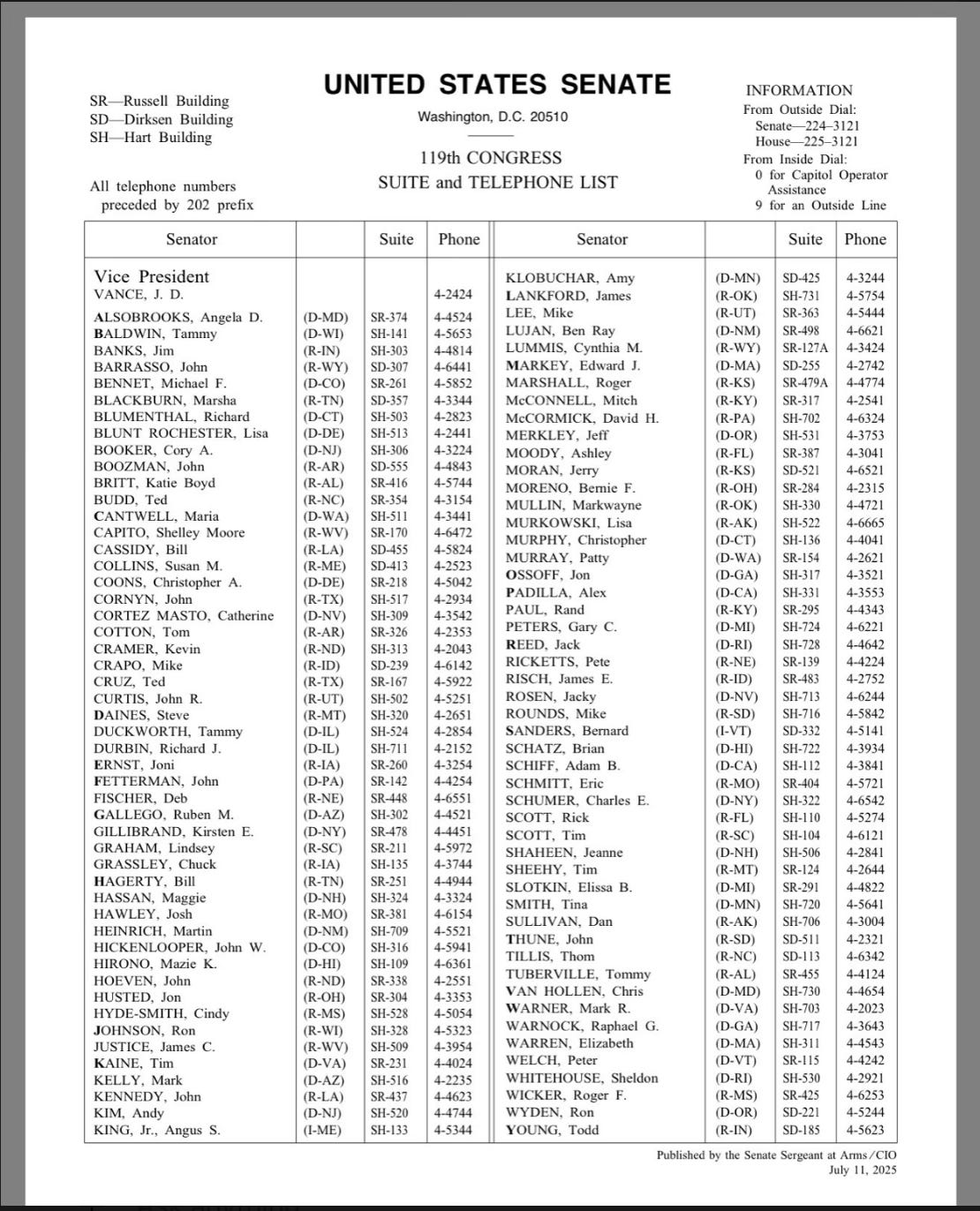
Below is a list of phone numbers for each U.S. Senator. While Senators are elected to represent constituents from their own states, you are not limited to calling only your Senators. You may contact any Senator to state your outrage and your expectations regarding ICE funding.
Feel free to call them — one by one, if you have the time and feel so inclined. Do not explain yourself. Do not debate. Do not negotiate tone.
State your demands. Ask where they stand. Then move on to the next call.
This is how pressure is applied.
Protect Your State and Local Community
Before taking action locally, it’s important to understand how ICE operates at the state and local level — because this isn’t just about “assisting” a federal agency. It’s about paid cooperation and voluntary agreements that give federal immigration power deeper reach.
The 287(g) program is one of the main ways local governments partner with ICE. Under Section 287(g) of federal law, ICE can enter into agreements with state and local law enforcement agencies that authorize certain officers to perform immigration enforcement duties they normally would not have authority to do on their own. This includes identifying, questioning, processing, and detaining people for immigration enforcement under federal direction.
Local governments often participate by:
Assisting ICE operations — providing personnel, information, or facilities.
Sharing data and intelligence with ICE.
Participating in joint task forces with federal immigration agents.
Signing 287(g) agreements that deputize local law enforcement officers to enforce federal immigration laws.
Housing detained immigrants in local jails or facilities under federal agreements.
Under a 287(g) agreement, a local agency’s officers receive training from ICE and can act in certain immigration enforcement roles under federal supervision. Participation is voluntary — local governments choose to enter into these agreements, and they can withdraw from them.
That means cooperation with ICE is not inevitable. It is chosen, funded, and renewed — and it can be ended. Stopping cooperation doesn’t just send a message.
It cuts off money, access, and infrastructure that ICE relies on to operate locally.
What This Means for Your Community
Every local 287(g) agreement or cooperative contract expands federal reach into everyday policing. Critics say the program blurs the lines between community policing and federal immigration enforcement, erodes trust between residents and law enforcement, and diverts local resources away from public safety.
It does not have to stay that way. Local elected officials and law enforcement leaders can refuse new agreements, revoke existing ones, and stop cooperation immediately.
Here is sample language you can use to demand that from your local officials:
Subject: Demand Immediate Action to Block ICE Operations in Our Community
I am a resident of [state/county/city], and I am writing to demand immediate action to protect our community from Immigration and Customs Enforcement (ICE).
ICE agents have killed U.S. citizens, including Alex Pretti and Renée Good. Continued cooperation with this agency is unacceptable. As an elected official, you have the authority to refuse participation in federal enforcement actions that endanger residents and undermine public safety.
I expect you to take immediate steps to:
• Refuse all cooperation with ICE and CBP
• Revoke any 287(g) agreements and prohibit future participation
• End all joint operations, task forces, and data-sharing with ICE or DHS
• Deny ICE access to state, county, or city facilities, personnel, and resources
• Declare schools, hospitals, courthouses, and public services ICE-free zones and prohibit ICE activity in those spaces
• Require transparency and public notice for any ICE activity in this jurisdictionYou may not control ICE as a federal agency, but you do control whether our state or local government assists it. I expect you to refuse that assistance immediately.
I also expect you to publicly oppose ICE operations in this jurisdiction and to act to keep ICE off our streets.
I want to know what concrete actions you are taking right now to protect the people who live here.
[Your Name]
[City, State]
[ZIP Code]
CALL FIRST. THEN SEND THE LETTER to those state and local officials listed below if you can. Calls create pressure and letters put it on the record.
State and Local Officials With the Power to Stop Cooperation with ICE.
1. Governor
Governors can stop state cooperation with ICE immediately through executive action.
They can suspend or terminate agreements, direct state agencies to refuse cooperation, and block the use of state resources — just like Abigail Spanberger recently did in the State of Virginia.
2. Attorney General
Attorneys General are the legal firewall.
They can:
investigate contracts and agreements with ICE
challenge unlawful cooperation
block state and local participation that violates the law
3. State Senators & State Representatives
State legislators authorize and protect these arrangements.
Tell them plainly:
you oppose any legislation that assists ICE
you do not want such legislation introduced
vote NO on any bill that funds or supports ICE cooperation
4. County Commissioners & Sheriff
This is where 287(g) agreements, jail contracts, and paid cooperation usually live.
Ask directly:
Do we have contracts or agreements with ICE?
Are we paid to assist ICE or to house detainees?
Will you revoke those agreements immediately?
5. Mayor & City Council
Cities control police departments, buildings, and public services.
Demand:
No cooperation with ICE
No joint operations
No use of city facilities, personnel, or resources
Assignments from Defiance.org
The following actions are adapted from a mission issued by Defiance.org, founded by Miles Taylor, a former senior Department of Homeland Security official and national security expert.
I am a member of Defiance. You can learn more and sign up at Defiance.News.
On January 14, Defiance issued a concrete set of actions members can take when federal officers violate civil rights or state law. The core actions are:
1. Attend or host a Know-Your-Rights training.
Look for local trainings, or watch the Immigrant Legal Resource Center’s Know Your Rights session to understand how ICE encounters work and what protections exist.
2. Learn how to document ICE activity safely.
WITNESS provides clear guidance on how to record federal enforcement legally, ethically, and without putting yourself or others at risk. Elbows up. Cameras out. Document what you see — safely and lawfully.
3. Contact local prosecutors or police leadership.
Defiance encourages people to urge District Attorneys, prosecutors, and police chiefs to investigate unlawful ICE conduct in their jurisdictions.
4. Make your actions visible.
Defiance emphasizes that public, visible acts of accountability lower the barrier for others to act.
What This Looks Like in Practice
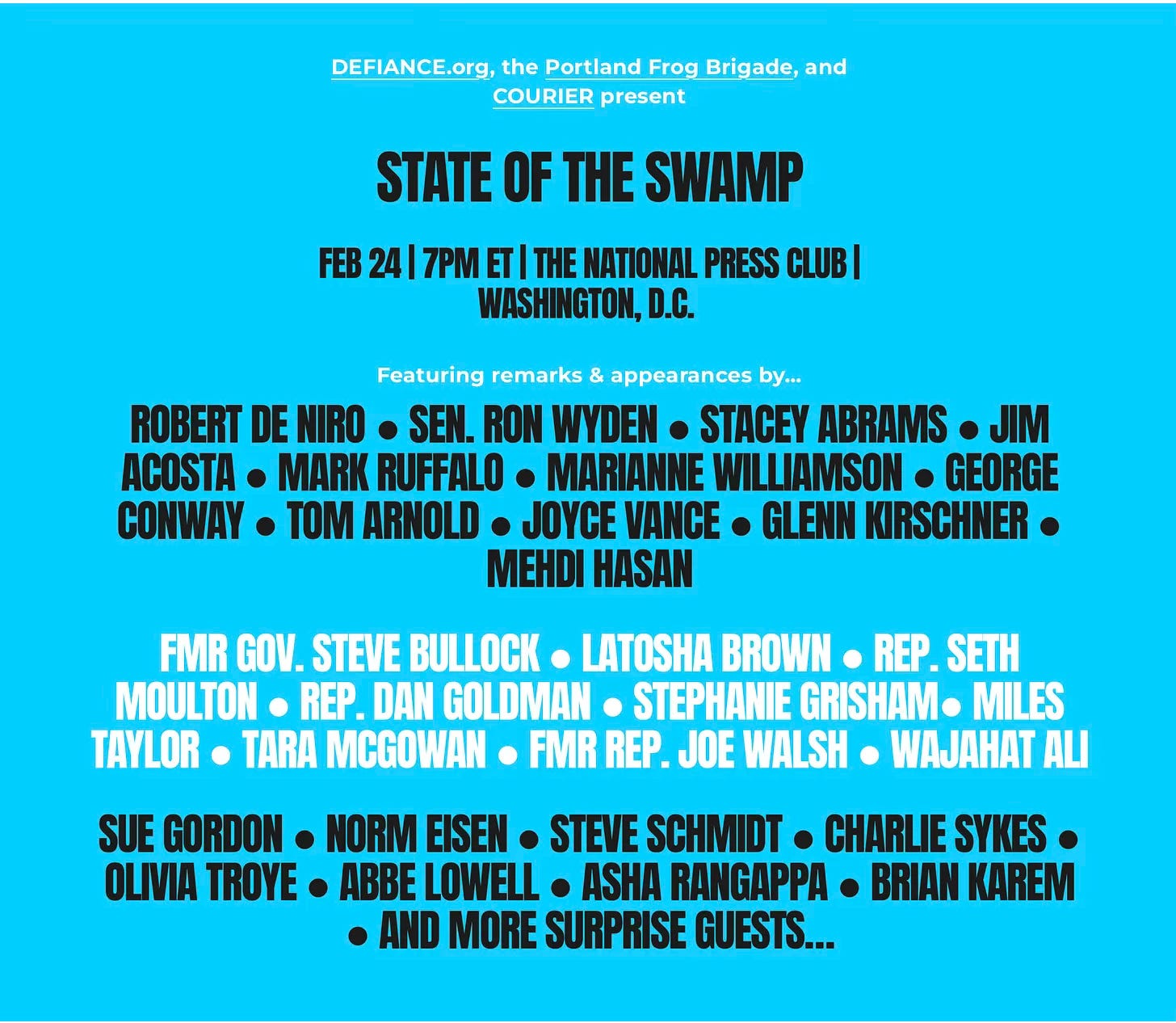
On February 24, while Donald Trump delivers his address inside the U.S. Capitol, Defiance.org and partner organizations will convene a public counter-gathering at the National Press Club in Washington, D.C. — State of the Swamp.
The event is open to the public. Tickets are available for purchase in person or online. If you are interested in attending, review the details and decide whether participation makes sense for you.
This is coordinated resistance.
Opposition leaders, elected officials, veterans, artists, journalists, and organizers will gather to tell the truth about abuses of power, the erosion of democratic guardrails, and the weaponization of government against dissent — and to show how Americans fight back together.
Expect:
Hundreds of attendees in coordinated green and frog attire
Live counter-addresses and real-time rebuttals
Music, visuals, satire, and serious truth-telling
National press presence
Clear actions participants can take the very next morning
This is what refusing normalization looks like in public.
These actions are summarized here with attribution to Defiance.News.
Connect With Local Resistance and Community Defense Groups
You don’t have to respond to ICE activity alone. Across the country, communities are organizing locally to prepare for, monitor, and respond to ICE enforcement actions — not with chaos, but with strategy, solidarity, and legal knowledge.
In many cities, grassroots networks and rapid response teams organize community members to watch for and document ICE activity, share alerts, and support those at risk. These networks serve as eyes and ears on the ground and help keep residents informed when enforcement actions occur.
Immigrant advocacy coalitions and community defense organizations regularly host Know Your Rights and ICE encounter trainings that teach people how to safely interact with immigration agents, understand their legal protections, and document encounters responsibly.
Some communities have formed rapid response networks with hotlines and volunteer teams for reporting ICE activity statewide or regionally. For example, the Colorado Rapid Response Network connects residents with trained volunteers when ICE is spotted.
In cities like Chicago and San Francisco, grassroots efforts combine education with practical tools — safety kits, alert systems, and community patrol models — to help neighbors notify one another and show up in solidarity during enforcement actions.
Organizations such as the Immigrant Defense Project, Organized Communities Against Deportations, and other local immigrant advocacy groups provide ongoing support, trainings, legal resources, and volunteer coordination that people can join or partner with in their own areas.
How to Plug In
You can get involved by:
Searching for a local rapid response or immigrant defense network in your city or state
Attending or organizing Know Your Rights trainings
Connecting with national resource hubs that link to local groups
Sharing information with neighbors, schools, faith communities, and local institutions
There are real groups doing real organizing right now. Joining or supporting them strengthens your community’s ability to respond to ICE activity safely, lawfully, and together.
Resistance Challenge
This isn’t about politics. It’s about our moral baseline. This is not a debate exercise. It’s a test of where someone draws the line when the state kills American citizens.
Call, text, or email the people in your life — friends, family, and people you do business with — and ask them one simple question:
“Are you okay with federal agents executing Alex Pretti?”
The entire world has seen the video. People watched it happen.
If the answer is anything other than an unqualified “No,” take that seriously. If someone can excuse, justify, or minimize this, that tells you something real about their values — and whether they belong in your life going forward.
Choose wisely.
This is the Line
There can be no “business as usual” after this past weekend. Helplessness is a lie we are taught. Democracy survives only when citizens refuse to outsource responsibility.
You are not meant to do this alone. Stay connected. Act in community. Collective action is how pressure becomes change.
You have been given seven concrete actions you can take this week:
to honor the young lives taken far too soon, support and uplift the nursing strike in honor of Alex Pretti, apply pressure to federal, state, and local officials, cut off cooperation, build local support, prepare responsibly, and refuse normalization.
Not everyone has the same time, energy, or resources. If you can do all of these things, do all of them. If you can only do one, do one — but do not do nothing.
None of this is symbolic. All of it matters.
If you want to better understand peaceful resistance — how it works, why it works, and why discipline matters — read the work of Gene Sharp and study the history of nonviolent movements that succeeded because ordinary people acted deliberately and together.
This is the line. It will not be crossed
A true patriot whether you are a police officer, national guard, or armed forces is one that fights for those who can’t fight. To fight for what is right vs. wrong.
It’s a war, between this administration and the STATES. Testing to see How Much resistance. There WILL BE. 45-47 and administration is finding out we are fighting back every way possible. RE-POST. SHARE.
SHARE THE NAMES OF ALL THAT BE SLAUGHTERED , THEY ARE PATRIOTS
NOT. TERRORIST. 💔