

Who Do You Serve?
Land of the free because of the brave

I was born on the Fourth of July — not just on it, but into it.
Into the heat and the noise. Into red, white, and blue bunting, flags flying, clouds swirling, and flashes of light exploding across the summer sky. There was even a tornado that day, because apparently my origin story required both fireworks and a warning siren.
I have always loved that. It gave the day a kind of mythical absurdity, as if I had arrived in the middle of some American tall tale: a Yankee Doodle Dandy born into the storm while the whole sky exploded.
When I was little, the Fourth felt magical. The parades, the marching bands, the backyard cookouts, the watermelon, the sparklers, the fireworks over humid summer nights — all of it seemed to belong to me and to everyone else at once. I never resented sharing my birthday with the country. I loved the largeness of it. I loved the feeling that, for one night, we were all gathered around the same bright idea: the great American experiment.
And I loved America.
Not because I believed in the myth of American exceptionalism. Not because I thought the country was innocent. I learned enough over the years to know better. America has always been both promise and contradiction. It has preached liberty while denying liberty. It has declared equality while forcing generation after generation to fight for it.
But I believed in the promise of the future. I believed the arc was still bending. I believed we were moving, slowly and painfully, toward a wider freedom and a deeper justice. I believed in the possibility of a more honest belonging, one where every person would finally be seen as fully equal: Black, white, brown, disabled, immigrant, poor, gay, trans, queer, Native-born, newly arrived — all of us.
That is why this birthday feels different. America is turning 250 years old, and the celebration does not feel like a party. It feels like a reckoning.
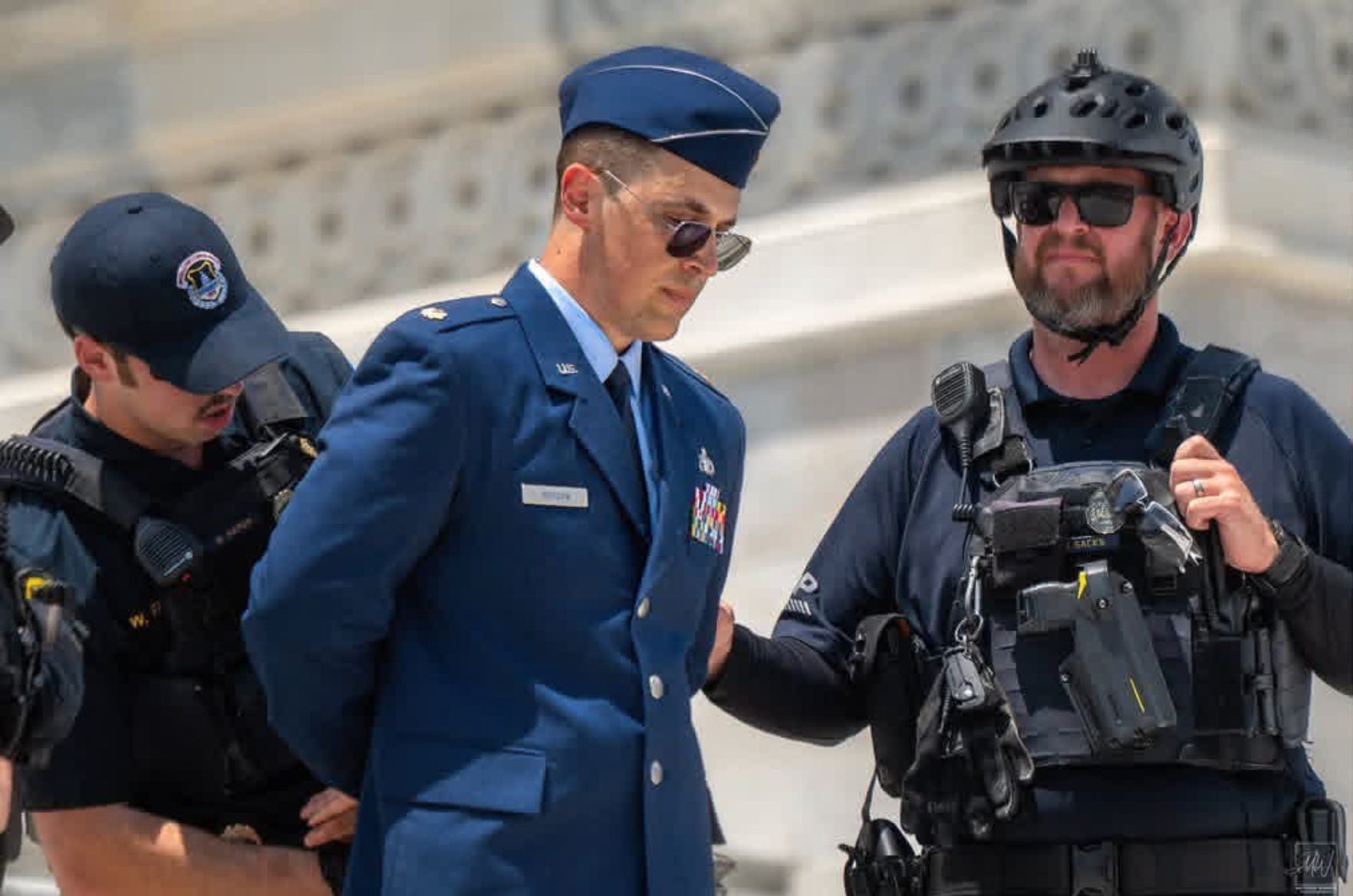
When U.S. Air Force Major Jason Watson was taken away in handcuffs on the Capitol steps after calling for constitutional accountability, it stopped me cold. The contrast was impossible to ignore.
The insurrectionists who stormed the Capitol smashed windows. They battered police officers. They pushed through barricades. They hunted lawmakers through the halls of Congress. Some carried weapons, zip ties, and bear spray. Some waved Confederate flags through the halls of American democracy. They did not merely trespass. They attacked the peaceful transfer of power. They wrapped themselves in the symbols of our nation while trying to overturn the will of its voters. They desecrated the Capitol and turned the American flag into a weapon.
But in the most grotesque twist of American history during my lifetime, their violence is excused. Their criminality is sanctified. Their assault on the republic is treated as something to forgive, minimize, and celebrate.
Because a snake-oil salesman and his band of sycophants pardoned almost 1,600 insurrectionists who tried to stop the peaceful transfer of power by force and folded them back into his cult as martyrs. He turned their criminality into grievance. He turned their violence into loyalty. He turned their attack on the republic into proof of patriotism.
Then the White House completed the lie in public. On an official government page, January 6 insurrectionists are recast as patriots. Their violence is laundered. Their records are transformed into persecution stories. Their assault on the Capitol is rewritten as a noble act of citizenship.
And then Major Jason Watson stands on the Capitol steps with a sign.
He does not smash any windows. He does not shove a police officer. He does not threaten a lawmaker. He does not carry zip ties. He does not spray chemicals into the faces of officers. He does not bring a Confederate flag into the halls of Congress. He does not try to overturn an election by force.
He simply stands there in uniform, holding a sign with three words: Impeach. Convict. Remove.
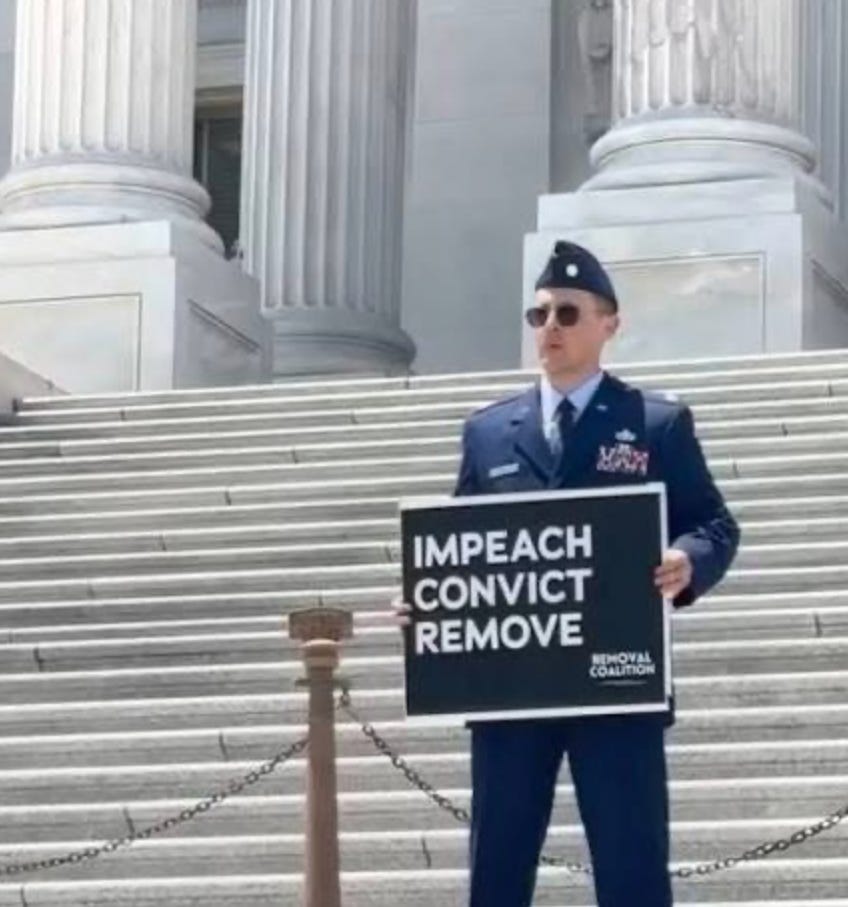
And he is taken away in handcuffs.
That does not mean there were no rules he knowingly broke. Civil disobedience is not the evasion of law. It is the public acceptance of consequence in order to expose the moral obscenity of the moment. Watson knew there would be consequences. And he stood there anyway.
A serviceman stood peacefully on the steps of the Capitol and was treated as the threat. An active-duty military officer invoked the Constitution in public and was taken into custody while honoring the oath he had sworn. That contrast should send chills down our spines.
What kind of country calls insurrection patriotism and conscience disorder? What kind of country treats loyalty to one man as love of country, and loyalty to the Constitution as disobedience?
An upside-down one.
Before his arrest, Watson made the constitutional argument himself. When a president orders military action against foreign countries “absent an emergency scenario” or an “imminent, dire threat,” he said, that is “an unconstitutional usurpation of Congress’ authority.” He named Cuba, Venezuela, and Iran. He called it “a violation of the War Powers Clause.” And he said the consequences were not theoretical: “These violations resulted in the deaths of 13 service members, and injuries of hundreds more.”
Citizens can argue about his legal claim. But they cannot honestly argue about why he did it if they truly believe in America.
Major Jason Watson came to the Capitol with an oath, a constitutional charge, a conscience, and the willingness to stand alone in public. He did not hide inside a mob. He did not conceal his face. He did not use violence as a substitute for courage. He did not demand immunity from the consequences of his choice.
He stood in uniform on the steps of the Capitol to say that the Constitution still matters. Congressional authority still matters. Accountability still matters. And no president is above the law.
That should not be a radical statement in the United States of America. But it is.
In the video of his arrest, Watson places his sign down and puts his hands behind his back. There is no chaos. No violence. No spectacle. No swagger. No threat. Just a man accepting the cost of standing where he believed he had to stand.
Then voices off camera begin to chant, “Who do you serve?” That is the question. Not just for Major Watson, but for all of us.
Do we serve a president, a strongman, a party, a lie — or do we serve the country itself? Not as a slogan, or merchandise, or pageantry, or a campaign prop. Not as a costume for people who betray it while draping themselves in its flag. But as a living promise that must be defended by ordinary citizens.
That is what this birthday is forcing me to confront.
I understand now more than ever why my grandfather, who fought on a battleship during World War II, stood so straight with tears in his eyes whenever the anthem played. Not for pageantry. Not for bunting. Not for political theater. For what had been paid. For service and sacrifice. For the country he had protected, and for the comrades who laid down their lives to defend it. He understood that freedom was not a decoration.
A flag cannot mean freedom if it flies over fascism. A flag cannot mean liberty if it flies over concentration camps of tents in the desert, masked raids, and human beings pushed into systems designed to strip them of names, rights, and witnesses.
And a military uniform cannot mean service to one’s country if the price of wearing it is silence in the face of constitutional betrayal.
That is why Major Watson’s stand moved me to tears. Because while powerful men strip America for parts and sell the pieces to the highest bidder, Watson reminds us what patriotism looks like when it costs something.
An active-duty serviceman in uniform calling for impeachment is not rejecting America. He is taking America seriously. He is insisting that the oath means more than ceremony. He is insisting that service to the country does not require submission to the powerful. He is insisting that conscience does not expire when a demagogue takes office.
Sometimes service requires obedience. Sometimes it requires resistance. Knowing the difference, and honoring the oath to protect and defend the Constitution against all enemies, foreign and domestic, is not a threat.
It is the definition of a patriot.
It is also the definition of courage: the willingness to be seen when silence would be safer. Telling the truth when lies are more profitable. Standing on the steps with a sign when the insurrectionists have been forgiven and the moral order has been turned upside down.
Freedom is not something we inherit and then leave untouched. It is not guaranteed by fireworks. It is not preserved by nostalgia. It does not survive because we honor it once a year. Freedom survives when people use it. When they speak. When they dissent. When they organize. When they refuse to let words like patriot and traitor be defined by those who have turned their backs on the republic. Freedom survives when ordinary people stop waiting for permission to defend it.
Major Watson reminds us that even when the People’s House is turned into a three-ring circus of loyalty, spectacle, and revenge, that is not a reason to give up on the country. It is the reason to fight for it.
Loving America right now means refusing to abandon it to the people who have betrayed it. It means refusing to let them have our flag, our anthem, or our country’s 250th birthday on the Fourth of July.
Ordinary citizens must commit to putting the country right side up again. Not someday. Now.
We do it by using whatever leverage we have, whatever platform we have, whatever circle of influence we have, whatever courage we can summon. We do it by standing up, speaking plainly, naming the lie, protecting the vulnerable, defending the institutions that still protect us, confronting the ones that are failing, and standing beside the people who are risking something.
Not with the kind of patriotism that demands applause and punishes questions, but with the stubborn, unglamorous courage of citizenship. The courage to defend the Constitution when it is being shredded by the people sworn to uphold it. The courage to stand beside others who refuse to kneel. The courage to ask, “Who do you serve?”
As for me, I serve the country Major Jason Watson is defending: a land still meant to be free, still called to be brave, and still worth fighting for.
Author’s Note
After publishing “Who Do You Serve?,” I came across the comprehensive, balanced piece on Major Jason Watson published by Air Force Times. Journalist Cristina Stassis did what legacy media should have done: she reported the facts, the context, the risk, and the rules. She notes that active-duty service members face strict limits on partisan political activity, especially while in uniform, and that violations can carry serious criminal or administrative consequences.
Major Watson was released by Capitol Police, but the matter is not over. Reuters has since reported that the Air Force will conduct its own investigation. In other words, Major Watson may still face serious consequences for what he did on the Capitol steps. A legal defense fundraiser has been set up for him on Spotfund. If you are able to contribute anything at all, I am certain it would be appreciated.
It is a sad state of affairs that more Americans do not know Major Watson’s name. His act was extraordinary: an active-duty commissioned officer, in uniform, publicly calling on our government to honor the Constitution he swore an oath to protect and defend against all enemies, foreign and domestic.
And yet legacy media has not covered this story with anything close to the seriousness it deserves. Please consider sharing this piece so more people learn about Major Jason Watson’s courageous stand.
Beautifully written. Brought me to tears. To honor your birthday and your contribution to the cause I have just subscribed. May honor and decency prevail. ❤️🇺🇸💙
So well said!!